March 2026 - The Colloquium for Information Systems Security Education (CISSE) announces the release of the Spring 2026 issue of its Journal publication. This volume features peer-reviewed academic papers presented at the 29th Colloquium (November 2025), hosted at Seattle University and co-hosted with The City University of Seattle, advancing the evolving body of knowledge in cybersecurity education. We extend our sincere appreciation to the authors, reviewers, and editors whose time, expertise, and dedication made this publication possible.
The 29th Colloquium was held jointly with the Conference on Cybersecurity, Education, Research, and Practice (CCERP). Papers from that conference are published separately and are available at CCERP 2025. We are grateful for their partnership and for the significant contributions their research makes to the broader cybersecurity education community.
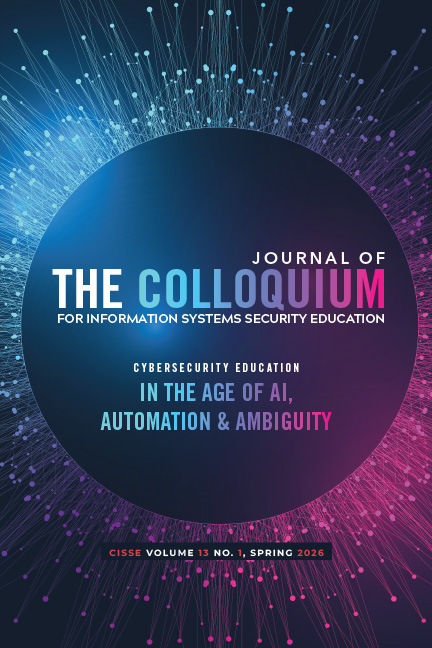
Print and Kindle editions are offered as optional formats for accessibility and archival purposes, with proceeds directly supporting the sustainability of the Journal and its mission.
Cybersecurity Education in the Age of AI, Automation & Ambiguity
The influence of social media, large language models, and increasingly sophisticated deepfake technologies continues to expand, affecting societal discourse, human psychology, and cybersecurity practices as educational institutions and organizations adapt their policies and training approaches. Although widespread quantum readiness remains distant for many organizations, threat analysis and mitigation strategies are already being developed for high-security environments. Meanwhile, immersive technologies such as virtual and augmented reality remain largely emerging for the general public, though niche applications are gaining traction and gamification continues to influence educational approaches. Education itself is undergoing significant transformation as institutions adapt to both the benefits and challenges associated with AI-enabled technologies.
The papers presented in this volume provide valuable insights for cybersecurity educators seeking to remain current with emerging technologies and evolving challenges. Artificial intelligence is now a common component of educational practice and research methodology. In addition, disciplines such as psychology and philosophy are emerging as important elements within the broader cybersecurity landscape—particularly in areas such as social media safety for children, AI-driven changes in human behavior, the proliferation of AI-generated content competing with authentic information, and the psychological dynamics underlying cyber attack and defense.
The Journal prioritizes open-access dissemination, ensuring all research is freely available to advance cybersecurity education. Accordingly, this issue is publicly accessible through our Open Journal repository.
View Full IssueContents
- A Case Study for Combating Student Overuse of Generative Artificial Intelligence in Cybersecurity Educational Activities Using Augmented Reality Capture-the-Flag Development
- A Deweyan Foundation for Cultivating Reflective Cyber-Attuned Habits in an Age of AI and Ambiguity
- A Systematic Review of Residual Risk in Cybersecurity Awareness Training
- AI-Driven Cloud Security: AIOps for Threat Detection and Compliance
- An AI Agent Workflow for Generating Contextual Cybersecurity Hints
- Analysis of Cybersecurity Risks and Teenage Digital Behavior Patterns
- Best Practices in Security Convergence: Tales from the Trenches
- Building Nuclear-Specific Cybersecurity Expertise in Higher Education
- CodeWars: Using LLMs for Vulnerability Analysis in Cybersecurity Education
- Cybersecurity Education with Generative AI: Creating Interactive Labs from Microelectronic Fundamentals to IoT Security Exploitation
- Deepfake-Enabled Infiltration: The Threat of Synthetic Identities in Corporate Environments
- Detecting and Mitigating AI Prompt Injection Attacks in Large Language Models (LLMs)
- Development and Validation of a Healthcare Workers Phishing Risk Exposure (HWPRE) Taxonomy for Mobile Email
- Distributed Agency in AI-Enhanced Cybersecurity Education: A Posthuman Instructional Design Framework
- Enhancing User Resilience Against AI-Augmented Phishing: A Two-Stage Framework for Detection and Personalized Training
- EQīLevel: Emotion-Aware Reinforcement Learning for Adaptive Academic Tutoring
- Exploring the Impact of Previous Experience, and Threats Awareness on Influencing Regular Information Backup Among USA Population
- From Creation to Detection: How Dataset Composition and Simple Augmentation Influence Deepfake Training
- From Social Sharing to Security Lessons: Behaviors, Disclosure, and Cyber Threats Best Paper
- Integrating Artificial Intelligence into Undergraduate Cybersecurity Education: A Course Design for Threat Detection, Explainability, and Ethical Resilience
- Mapping the Gap: Analysis of Nuclear Cybersecurity Education in U.S. Universities
- Play NICE: Incorporating Cyber Phraseology Into K-12 Education
- Roll With It: Awareness Raising with Cyber Defence Dice
- SecureAI: Toward Experiential Security and Privacy Training for AI Practitioners
- Securing Meaning: Language Equity in Cybersecurity Translation
- Self-Hosted Workflow Automation for AI-Based Cybersecurity Operation
- Study of AI Object Detection: Patterns on Animals with YOLO and Adversarial Patches
- Teaching Critical Infrastructure Security Through Interactive Experiences: Modeling Cyberattacks in Gamified Learning
- Teaching Endpoint Protection through Wazuh: A Project-Based Approach to Cybersecurity Education
- Unequal Risks: Ethnicity, Region, and Cybersecurity Outcomes in the United States
Copyright of the content remains in the hands of the authors, with free distribution encouraged. Usage requests in publication should be made directly to the authors.